
Every team ships apps now. Secure all of them.
APIs discovered from source. Real-browser testing. Evidence your team and agents fix and verify.

The newest apps are often the easiest to miss.
Finance builds dashboards. HR builds portals. Coding agents ship services. Internal does not mean safe.
One repeatable check for every app, inside or outside the firewall.

Discover from source. Attack in the browser. Verify the fix.
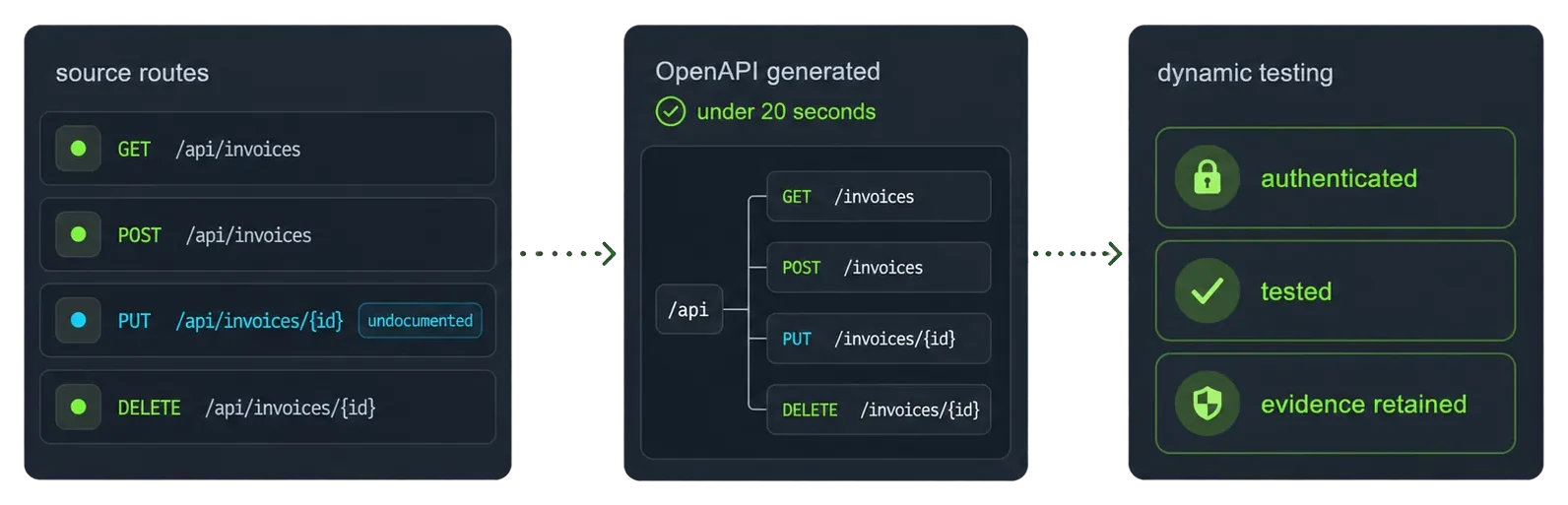
Discover from source
Deterministic local analysis turns supported source into an OpenAPI spec in under 20 seconds, including the routes your docs forgot.
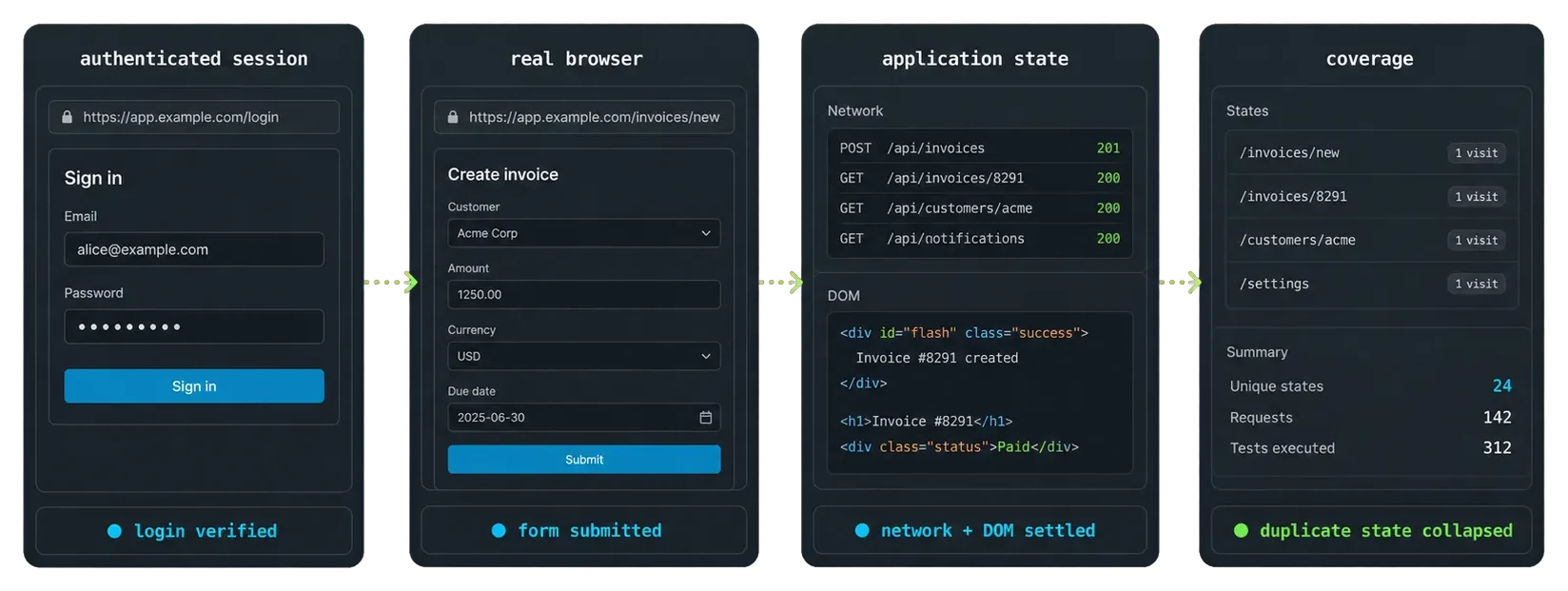
Attack in the browser
A real-browser crawler fills forms, waits for JavaScript, and scans signed in. Login preflight stops false clean results.
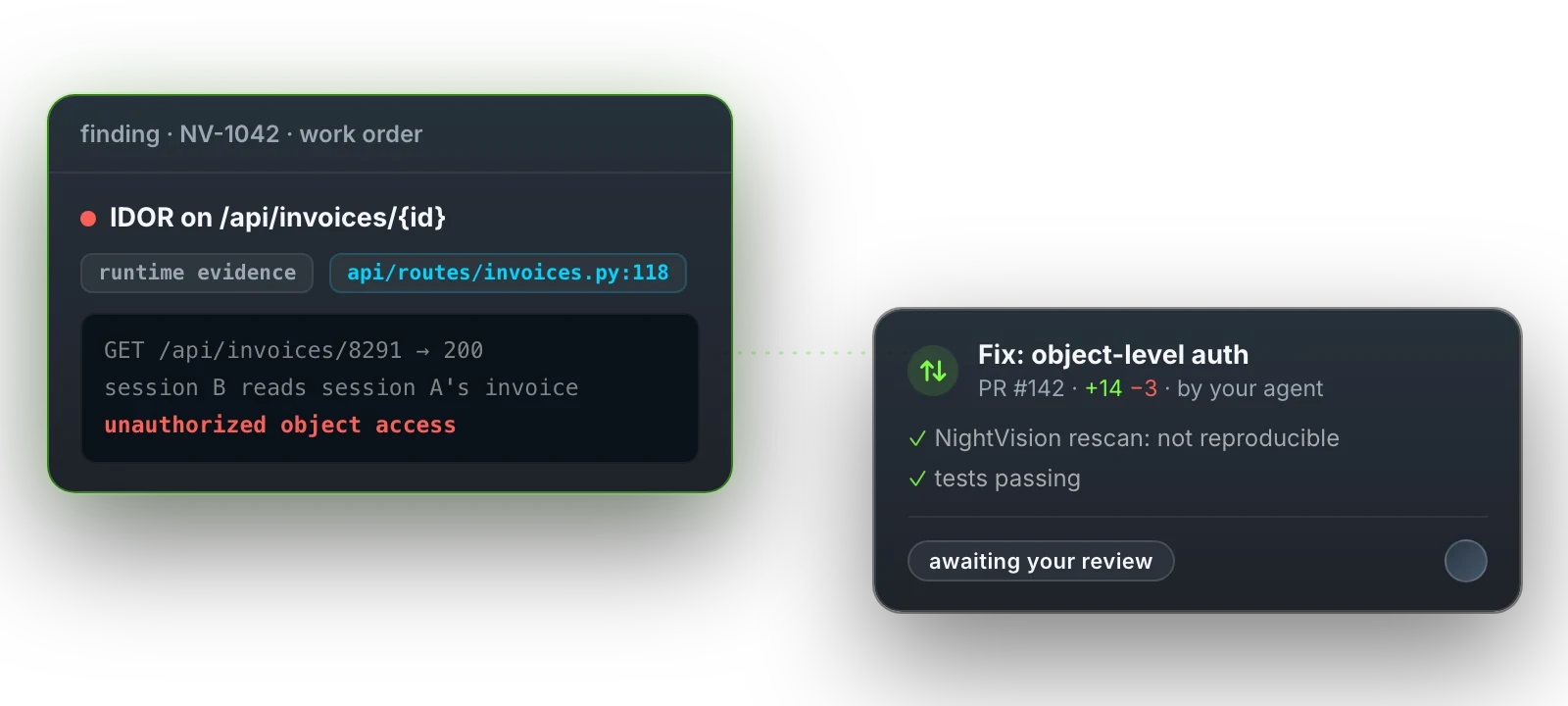
Verify the fix
Findings keep runtime evidence, with file and line where supported. Agents propose the fix, a rescan verifies it, humans merge.
Every finding brings evidence. Every fix gets rescanned.
Reproduce it
The exchange that proved it, plus a one-command curl repro.
Trace it
File and line on supported API findings, not a category.
Verify it
Green means it no longer reproduces.
In a head-to-head evaluation at a Fortune 500 healthcare company, NightVision scans finished 51% faster than the incumbent enterprise scanner, with fewer false positives.
Agents are only as good as the scanner they call.
MCP connects the workflow. NightVision supplies the evidence, and a rescan verifies the fix before a human merges.

Works with any MCP-capable coding agentClaude Code · Cursor · GitHub Copilot · Windsurf
Determinism on the finding, agents on the fix, humans on the merge.
"Our team won an internal hackathon award using NightVision."Steve McKinnon · BeyondTrust
Questions buyers actually ask.
What makes NightVision's DAST crawler different?
It drives a real browser with three mechanisms built for modern apps: LLM-based form handling that fills forms with valid, internally consistent values; WebDriver BiDi-based intelligent waiting that advances only when network and DOM activity quiesce; and duplicate page detection that collapses templated pages into one logical state.
Can NightVision run fully authenticated scans with MFA?
Yes. Record your login once with Playwright and NightVision replays it at scan time, with credentials automatically vaulted and TOTP/MFA supported. A login check verifies authentication before testing begins and fails the CI pipeline instead of silently scanning logged out.
Can NightVision scan undocumented APIs?
Yes. For supported REST frameworks, API discovery (API eNVy™) generates an OpenAPI spec from source code in under 20 seconds. It runs locally and uses deterministic static analysis, so recognized shadow and undocumented routes can be fed into dynamic testing alongside your web app.
Can coding agents use NightVision?
Yes. Through NightVision's open-source MCP server and Agent Skills, coding agents can launch scans, inspect runtime evidence, use source context where available, propose changes, and rescan. Repository controls and human review still govern the merge.
How does NightVision handle vibe-coded and AI-generated applications?
AI-assisted development creates applications faster than security teams can inventory them, often outside traditional pipelines. NightVision scans any running web app or API, discovers endpoints from source where a repository exists, and lets coding agents launch scans as part of the build itself, so new applications get tested instead of slowing down.
Is there a free trial?
Yes. NightVision offers a self-serve free trial with no credit card required. Paid plans start at $15,000 per year for a single application with unlimited seats, and custom enterprise pricing is available for teams.
See what your applications actually expose.
Map it from source and the browser, test it fully authenticated, and get evidence your team and agents can act on. Self-serve trial, no credit card. SOC 2 Type 2.
Evaluating DAST tools? See how NightVision compares to Checkmarx, Bright Security, and other DAST and API security scanners.